

Program Description
PeerLearning.net is a web-based platform that helps teachers design and deliver cooperative learning (CL) lessons with fidelity to best practices across any subject and grade level. Teachers use the platform to build structured small-group lessons from their existing curricula using lesson templates such as jigsaw or group projects. During lesson delivery, the platform manages student grouping and lesson logistics, including distributing materials to student devices, directing activities according to a timed sequence, supporting teacher observations of student taskwork and teamwork, and guiding post-lesson group reflection. PeerLearning.net removes the planning and management tasks that typically prevent teachers from implementing CL with fidelity to best practices. PeerLearning.net is designed for use in standard academic instruction in any subject and can be implemented at any grade level as long as students are capable of reading instructions on their devices (typically 4th/5th grade and up).
Any teacher can use PeerLearning.net, either on their own or in collaboration with colleagues. Lessons developed within PeerLearning.net can be shared with other teachers through the global library, which has hundreds of lessons created by teachers in various subjects throughout middle and high school, including core subjects (e.g., math, social studies, ELA), as well as social-emotional learning (SEL), organizational/study skills, career preparation, and financial literacy.
Program Outcomes
PeerLearning.net has been evaluated in two cluster randomized trials with a combined sample of over 1,500 students in grades 6–9 across 25 middle and high schools in Oregon, Arizona, and Washington during the 2021–22 and 2023–25 school years.
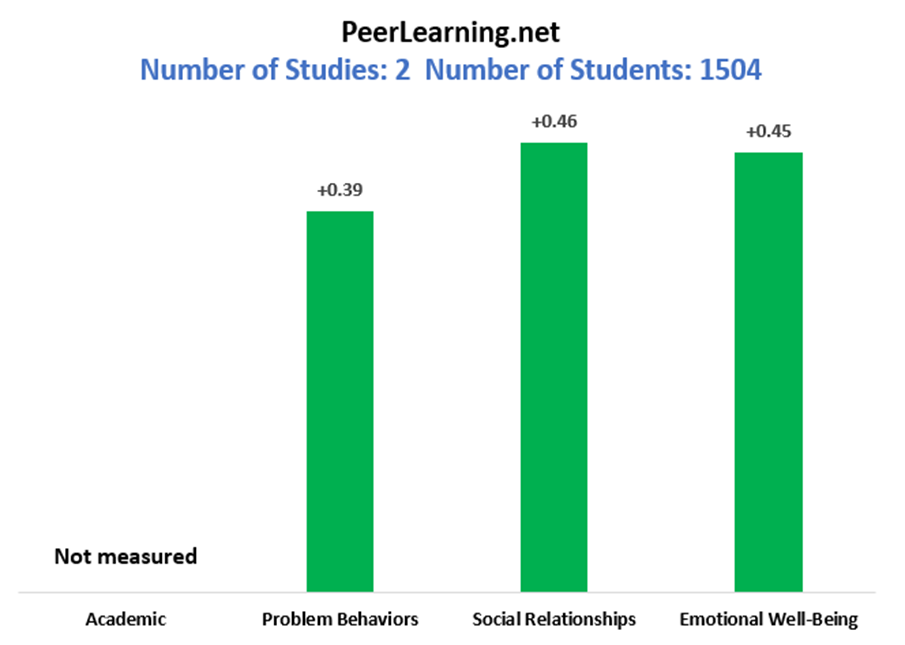
Across both studies, students in PeerLearning.net schools showed significant improvements in social relationships, including peer relations, prosocial behavior, social-emotional skills, and reduced discrimination (average effect size = +0.46). Students also showed significant reductions in problem behaviors, including victimization, bullying, alcohol and substance use, deviant peer affiliation, and peer stress (average effect size = +0.39). In the area of emotional well-being, students in PeerLearning.net schools reported significantly lower anxiety, depression, loneliness, mental health problems, and stress (average effect size = +0.45). In the first study, effects were consistent across sex, race/ethnicity, and grade level, and dosage analyses confirmed that each additional lesson taught produced significant gains on every outcome. The second trial notably found reductions in anxiety and depression using clinical measures (GAD-7 and PHQ-A), strengthening confidence in PeerLearning.net’s impact on adolescent mental health.
Across two randomized trials, PeerLearning.net produced consistent significant impacts on students’ social relationships, problem behaviors, and emotional well-being, earning a Strong rating and a badge for having two studies meeting the Strong standard. Notably, these broad benefits are produced not through a dedicated prevention curriculum but through everyday academic instruction, with PeerLearning.net supporting teachers in implementing structured small-group learning with fidelity to research-based best practices while reducing teacher preparation time and organizational burden during the lesson.
Staffing Requirements
No special staffing is required.
Professional Development/Training
Teachers can typically learn to use PeerLearning.net within 1 hour. Training can be provided to an entire staff, or to an individual teacher, or anything in between.
Technology
PeerLearning.net is 100% Web-based and integrates with Google Classroom. Both teachers and students must have devices (e.g., Chromebooks, tablets).